
When Growth Isn’t a Movement
Recovering Mobilization, Network Theory, and Multiplication

The word movement is used freely in church leadership circles. Attendance increases, and we call it a movement. Programs scale, and we call it multiplication. Influence expand,s and we assume the Kingdom is advancing.
But not everything that grows is a movement.
And not everything that expands is multiplying.
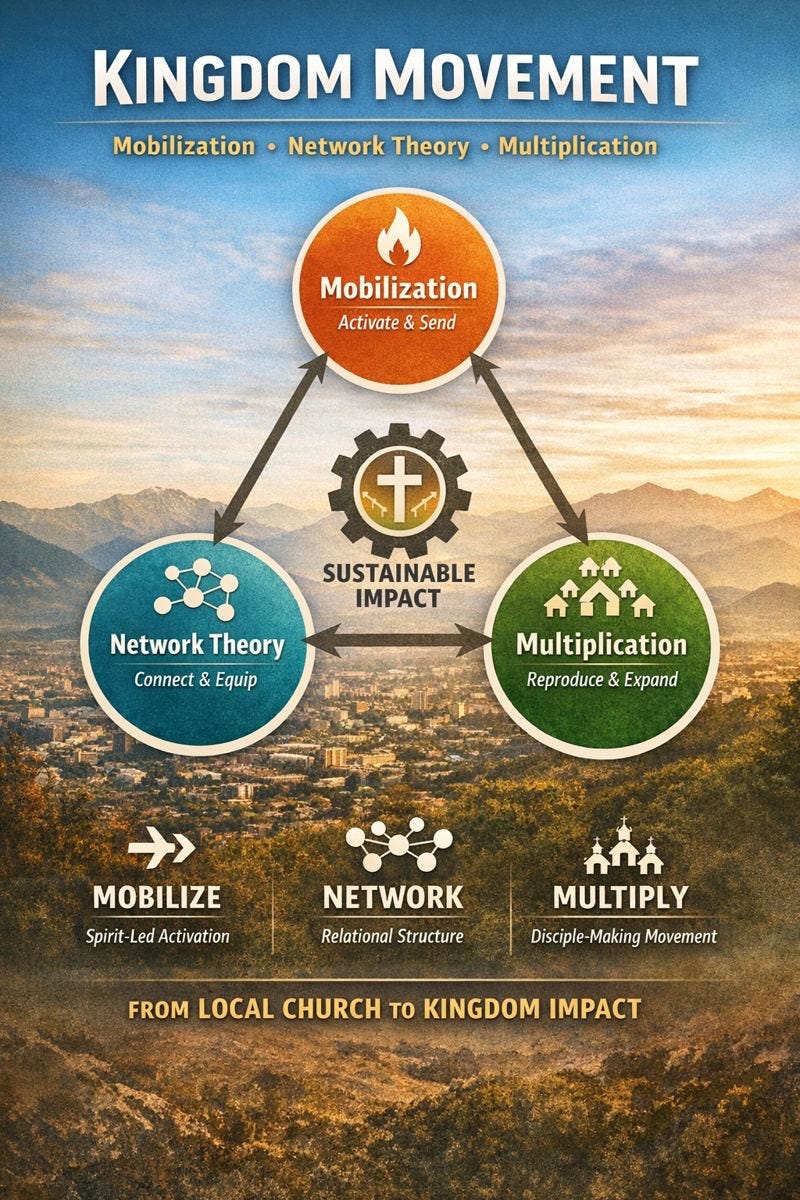
If we are serious about gospel saturation—disciple-making, leader development, and church planting at scale—we must recover an integrated vision that holds together mobilization, network theory, and multiplication. When aligned, this triad becomes a flywheel for sustainable, Spirit-led impact. When separated, it produces burnout, fragility, or isolated success.
As Alan Hirsch has rightly observed, “Movements are not built by adding people to the church, but by releasing the church into the world.”¹ Release, however, requires more than passion. It requires a structure capable of carrying obedience across time and context.
Mobilization: The Engine of Activation
Mobilization is the Spirit-driven activation of people, leaders, and churches into their sent identity. It is not volunteer recruitment; it is vocational awakening. Mobilization shifts the church from being a gathered audience to a participating people.
Throughout mission history, seasons of advance have always been preceded by mobilization. Yet mobilization by itself is unsustainable. Ralph Winter consistently warned that zeal without systems leads to collapse, arguing that structure is not opposed to the Spirit but is often the means by which the Spirit sustains what He initiates.²
Mobilize people without providing relational pathways, and the result is enthusiasm without endurance—energy without continuity. Mobilization creates motion; it does not determine direction or longevity. For that, we need networks.
Network Theory: The Architecture That Carries Movement
Network theory helps explain how movements actually spread. Sociological research has demonstrated that influence flows primarily through relationships rather than institutions. Manuel Castells famously described networks as the fundamental units of social organization in the modern world.³
This insight is not new to the Church. The early Christian movement expanded through interconnected house churches, apostolic teams, and city hubs linked by shared mission and trust. Authority was relational. Leadership was distributed. Learning circulated through correspondence, travel, and imitation.
Network theory clarifies three movement dynamics:
Leadership must be distributed rather than centralized
Learning must circulate rather than accumulate
Capacity must scale relationally rather than bureaucratically
Everett Rogers’ work on diffusion reinforces this reality, demonstrating that ideas spread through social systems over time via trusted relational channels.⁴ The gospel travels the same way.
The Church → Network → Collective → Hub framework reflects this logic. Churches remain locally rooted. Networks foster shared learning and encouragement. Collectives align leaders across networks. Hubs provide backbone support without exerting control.
As Michael Frost has argued, the future of mission depends less on institutional expansion and more on communities of people living sent lives together.⁵ Networks create the relational architecture that allows mobilization to endure.
Multiplication: The Only Honest Measure of Movement
Growth adds; multiplication reproduces.
A movement is not defined by how many attend but by how many are equipped, released, and reproduced. Multiplication includes disciples, leaders, churches, and eventually networks themselves.
David Garrison’s research into church planting movements revealed a consistent pattern: movements do not depend on exceptional leaders but on ordinary believers obeying God at scale.⁶ Multiplication is not the result of charisma; it is the outcome of reproducibility.
This insight echoes Roland Allen’s earlier conviction that genuine expansion occurs when the gospel is allowed to take root indigenously without external control.⁷ Where local believers are trusted to lead, teach, and multiply, movement follows.
Mobilization fuels obedience.
Network theory shapes pathways.
Multiplication reveals whether movement is truly occurring.
Remove any one of these, and the system falters.
Why This Matters Now
In many contexts, the institutional church is experiencing fatigue. Leaders are stretched thin. Churches feel isolated. Programs often struggle to produce lasting fruit. At the same time, hunger for something more relational, reproducible, and resilient is growing.
This moment calls not for novelty, but for integration.
Mobilization without networks exhausts people.
Networks without multiplication preserve structures.
Multiplication without mobilization produces sporadic impact.
Lesslie Newbigin insisted that the Church is not the guardian of the gospel but its witness.⁸ Witness, by definition, is dynamic. It moves through people, relationships, and communities.
A Word to Leaders
If you feel the tension—energized people but no container, big vision but unclear pathways—you are not failing. You are confronting movement logic.
Begin relationally:
Build or join a network of four to six churches
Align with other networks into a collective
Connect to or form a hub that exists to serve, not control
This is not merely strategy. It is theology practiced at scale.
The early church functioned as a network. Paul wrote to hubs. Leaders traveled in teams. Authority was shared. The gospel moved along relational lines.
When mobilization, network theory, and multiplication converge, we do not merely grow—we participate in the advance of the Kingdom.
Let us build for that kind of movement.
Footnotes (Chicago Style)
Alan Hirsch, The Forgotten Ways: Reactivating the Missional Church (Grand Rapids: Brazos Press, 2006), 23.
Ralph D. Winter, “The Two Structures of God’s Redemptive Mission,” Missiology 2, no. 1 (1974): 121–139.
Manuel Castells, The Rise of the Network Society, 2nd ed. (Malden, MA: Blackwell, 2010), 500.
Everett M. Rogers, Diffusion of Innovations, 5th ed. (New York: Free Press, 2003), 11.
Michael Frost and Alan Hirsch, The Shaping of Things to Come (Peabody, MA: Hendrickson, 2003), 15.
David Garrison, Church Planting Movements (Midlothian, VA: WIGTake Resources, 2004), 21.
Roland Allen, Missionary Methods: St. Paul’s or Ours? (London: World Dominion Press, 1927), 7–8.
Lesslie Newbigin, The Gospel in a Pluralist Society (Grand Rapids: Eerdmans, 1989), 116.